
General
Set up and configuration
- Assign required reading
- Manage app settings and notifications
- Home page image and document logo
- Manage categories
- Welcome text and news
- Hide items (archive content)
- Required reading reports
- Updating role name video
- Updating links to Strengthened Standards training video
- Onboarding kit
- Send email notifications
Manage users
Troubleshooting
Registers
Manage content
- Delete document
- Edit, review and approve process
- Edit, review and approve policy
- Create and publish new policy
- Create and publish new process
- Previous item version information
- Edit roles
- Edit release notes
- Hide items (archive content)
- Introduction to release management
- Manage document
- Manage regulations
- Publish multiple changes (in one release)
- Publish single item (manage changes)
- Download and print content
- Delete role
- Delete policy
- Delete process
- Delete or archive regulation
- Embed video
- Manage comments
- Send email notifications
- Show Remaining Articles (2) Collapse Articles
Audits
Training Resources
- Content updates training
- Process editing - editing the process sequence
- Upcoming training sessions
- Required reading training video
- Updating role name video
- Updating links to Strengthened Standards training video
- Scheduling updated audits video
- Work instructions training video
- Comments training video
Business units
Reports
Required Reading
Work Instructions
Mobile Phone App
Comments
Custom audits
Manage business units for registers
This article applies to customers with registers (i.e. incident, complaint and feedback) who would like to limit visibility to specific Business Units (BUs).
Create Business Units
Step 1
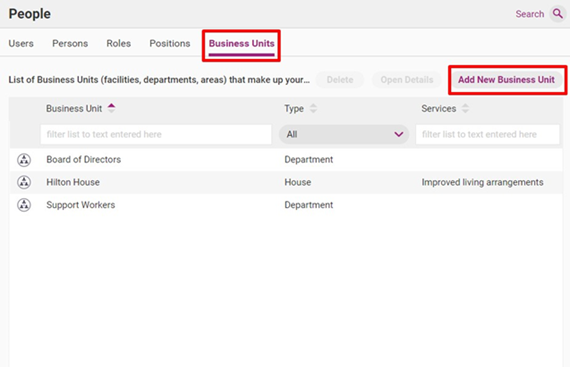
Access the People tab, click on the Business Units subtab.

Step 2
Click Add New Business Unit.
Step 3
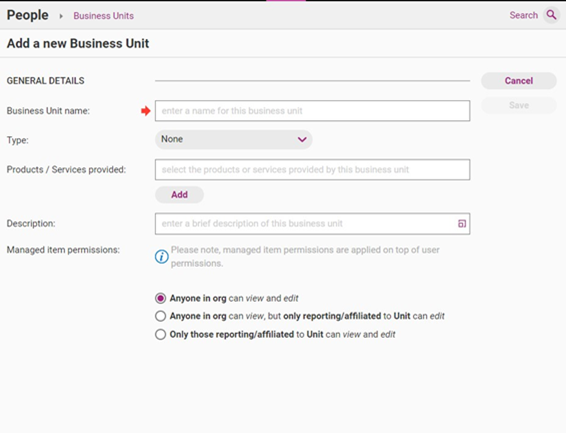
Enter details of the Business Unit, refer to the guidelines below.
Field | Description |
|---|---|
Business Unit name | The name of your BU. |
Type | The type of BU (i.e., House, Facility or Department). A BU can be created for a specific House (eg. Smith Street House), Facility (eg. Smith Family Services) or Department (Support Workers). |
Products/services provided | A list of the services or products that the business unit provides. |
Description | An overview of key information about the business unit. |
Managed item permissions | The viewing and editing permissions of the people linked to this business unit, options include: Anyone in org can view and edit – this means that any user in the system can edit and view web app content that has been assigned to this BU. Only those reporting/affiliated to Unit to view and edit – this means that only users linked to this BU can view and edit any content associated with this BU. Please note, that the viewing and editing permissions above will be applied on top of existing permissions. |
Step 4
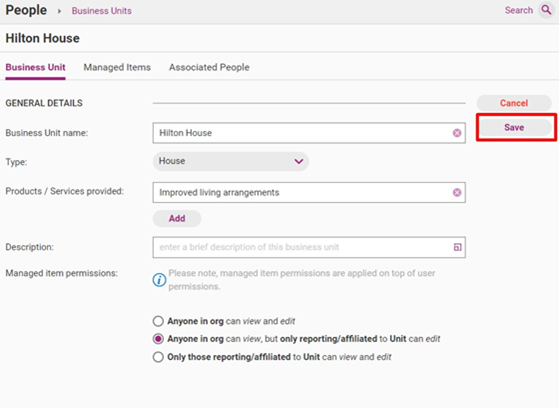
Click Save.
Tip
Once created, Business Units can be assigned to relevant content in the QMS, including:
- Policies
- Processes
- Documents
- Work Instructions
- Regulations
- Register items (incidents, complaints, improvements feedback)
Initiate editing of relevant items, to assign the Business Units to those items.
Link users to Business Units
Tip
If you are setting up the Business Units restrictive viewing function, only for use in Registers and not content, this can be done through Positions rather than the Users tab.
Refer to Setup Positions to be assigned to tickets (if applicable) at the end of article.
Step 1
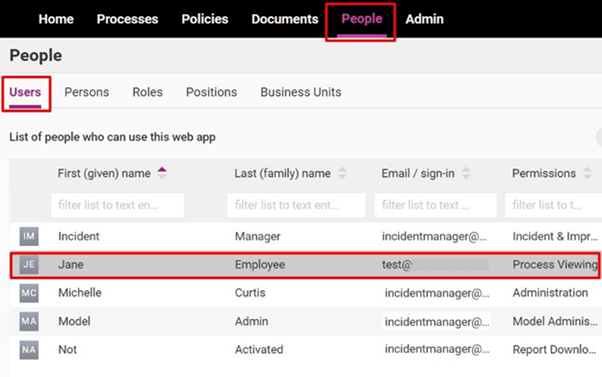
Go to People > Users and double click on the relevant user.
Step 2
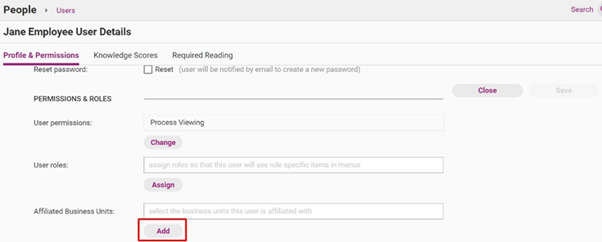
Scroll down to Affiliated Business Units and click Add.
Step 3
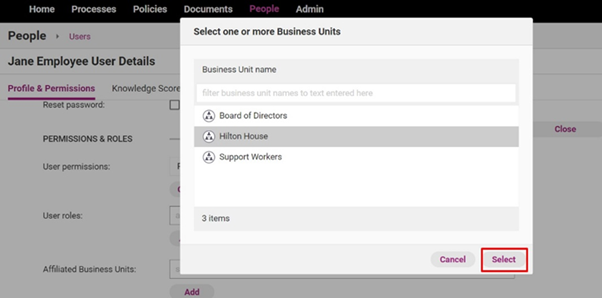
Select the BU that applies to the user.
Step 4
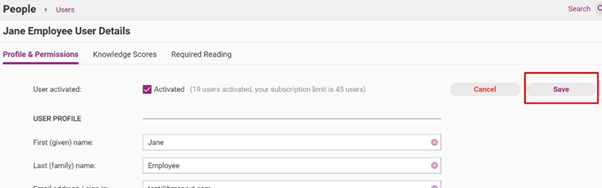
Click Save.
Tip
- New customers still yet to onboard your employees, please reach out to [email protected] and our team can assist in performing a Bulk Upload which includes Business Units under the User tab. This includes sending out ‘Welcome’ email invites.
- Regardless of the BU settings turned on, the user will still need to have ‘Edit’ capability to be able to edit content in the web portal (see Manage Users for more information).
- Multiple BUs can be assigned to a single user.
See Manage Users Guide for more information.
Setup Business Unit register management settings (if applicable)
Web application behaviour when regular users (e.g. users with Process Viewing Permissions) submit an incident, complaint or feedback differs from when users with Incident & Improvement Manager permissions report/manage incidents, complaints or feedback.
These settings allow users to control visibility of incidents/complaints/feedback, that are reported by users, that do NOT have Incident & Improvement Manager permissions.
The instructions below relate to configure the visibility of register items, based on existing BUs.
Step 1
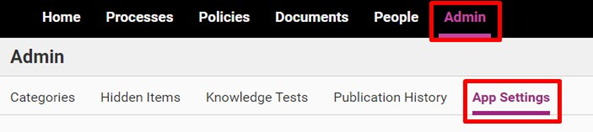
Go to Admin > App Settings.
Step 2
Scroll to Incident management type.
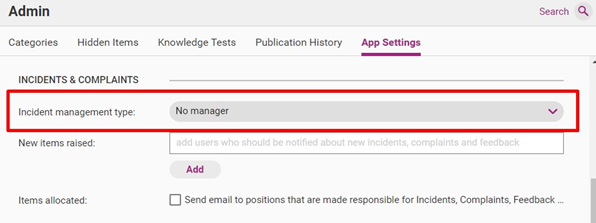
Step 3
Select one of the following management types.
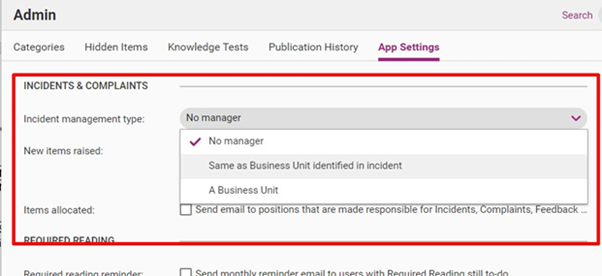
Management type | Description |
|---|---|
No manager | This is the default option. Managing Business Unit will not set. |
Same as Business Unit identified in incident | If a regular user has selected a specific business unit when submitting incidents/complaints/feedback, this setting ensures that the item submitted only visible by and managed by that specified business unit. Incidents/complaints/feedback will NOT be visible to users that are outside the business unit specified by the regular user who originally submitted the incident/complaint/feedback. A Business Unit manager can also be assigned as a default if no Business Unit is selected by the user. |
A Business Unit | This option ensures that incidents/complaints/feedback raised by regular users will be managed by a single business unit (which users then must select underneath when the business unit selection field appears). Incidents/complaints/feedback will NOT be visible to any users outside the business unit. |
Step 4
Depending on the option selected. see below:
a) If you selected 'No Manager', business unit will not be set, and setting will be saved.
b) If you selected 'Same as Business Unit identified in incident', chose the default Business Unit that would be allocated if the user left the 'Affiliated Business Unit' field blank when creating the ticket.
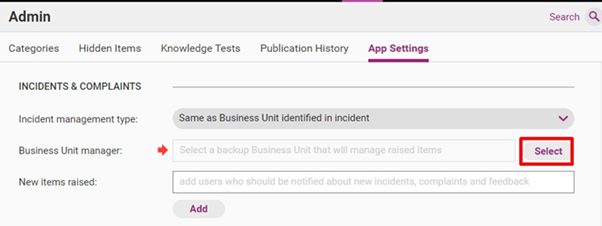
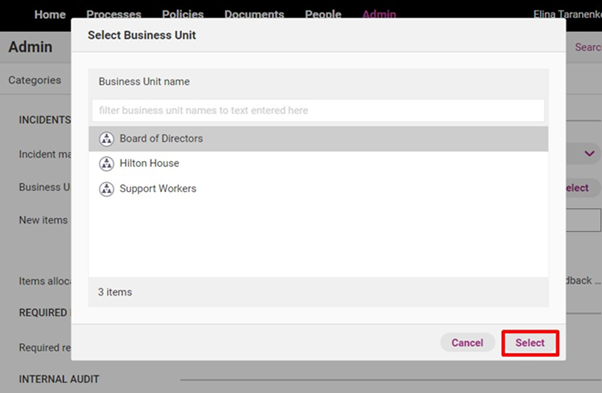
c) If you selected ‘A Business Unit’, chose the overarching BU for all tickets by clicking Select in the ‘Business Unit Manager’ field. This will be the Business Unit that will see and manage all Incidents/ complaints/ feedback. Tickets will NOT be visible to users outside the business unit until the ticket is updated with a new ‘Managing Business Unit’ or a Position has been assigned.
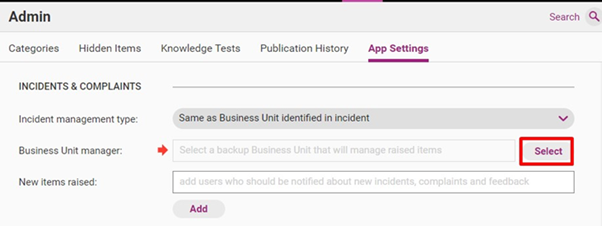
Step 5
Click once on the relevant BU and click Select and settings will be saved.
Setup Positions to be assigned to tickets (if applicable)
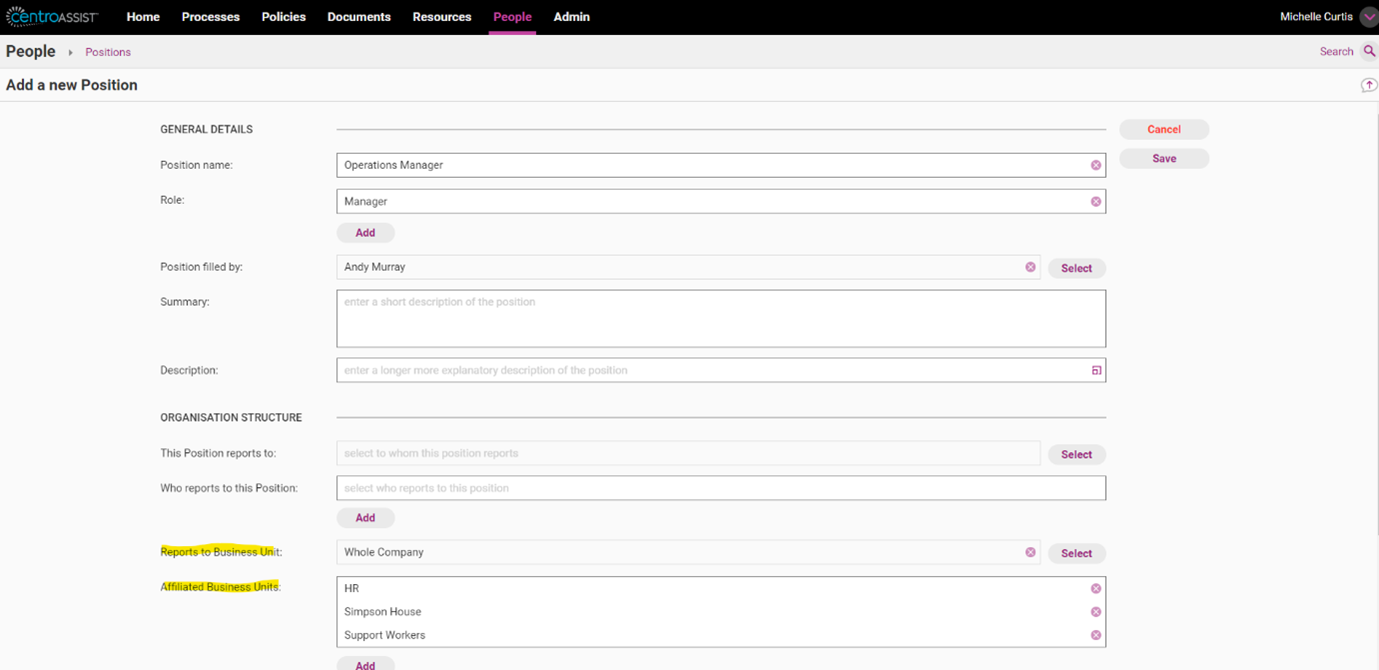
To assign incidents, complaints and feedback to team members to manage, a Position needs to be created for each of these employees.
Step 1
Go to People > Positions .

Step 2
Click on 'Add New Position'.

Step 2
Add the following information:
Tip
- Only positions are needed for team members that you plan to assign/manage incidents, complaints and feedback.
- If using restrictive viewing only for Registers and not general content, you can do this through a Position setup.
- Users require the ‘Incident & Improvement Manager’ permission on their profile to be able to view tickets. Team members with ‘Process Viewing’ can only raise a ticket.
- No matter what Business Unit a Position has been assigned too, if you add them to a ticket, they will see all the information on the ticket.
- Multiple Positions can be assigned to a ticket.
Complete
You have now configured your register management settings.